
On Murmuring Ghosts
Quantum magnetometry, AI, and other forms of bafflegab

As a quantum physicist, I often wish that there was more public attention paid to the field, because I am willing to mount a serious case for quantum physics as the greatest intellectual achievement of human civilization (to this point), and I’d like more people to appreciate just how awesome it is. At the same time, though, there’s a bit of a monkey’s paw quality to that, because when the idle wish for more quantum publicity is granted it’s often, well…

Sigh.
So, what do I make of this claim that a combination of “quantum magnetometry” and “AI” were the key to locating this downed pilot inside Iran? Well, my favorite response came from my distinguished former colleague Charles Clark on ex-Twitter:
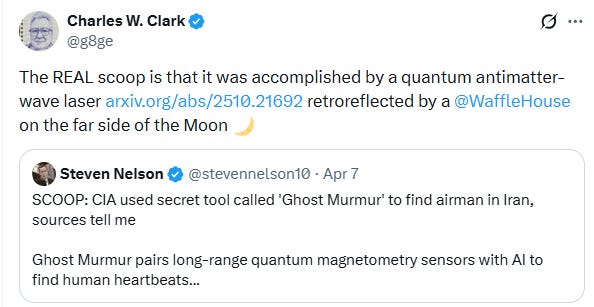
Adding the words “antimatter-wave laser,” “Waffle House,” and “far side of the Moon” don’t make the core claim any less plausible.
But, you know, as science communicators, we go into metaphorical battle with the news hook we have, not the news hook we would prefer to have… So I fielded a call from a reporter for Scientific American yesterday, and provided some quotes for their article on the subject, which I’ll expand on a little bit here, in a Q&A format that’s hopefully reasonably compact.
What is quantum magnetometry, anyway?
It’s pretty much what it says on the tin, if you parse the root words: a collection of techniques using quantum phenomena to measure tiny magnetic fields. There are two main ways of doing this, one using Superconducting Quantum Interference Devices (SQUIDs) to measure the magnetic field passing through a tiny loop of superconductor, the other using laser spectroscopy of atoms (or atom-like things) to detect energy shifts caused by minute magnetic fields.
The fields here can be stupendously tiny— the best quantum magnetometers or sensitive to something like one ten-billionth of the magnetic field of the Earth— which opens the possibility of measuring really small sources. I did some workshops on quantum sensing last summer, and it was fun to read about things like using magnetic sensors to detect defects in ion traps by picking up the field induced by currents moving around on a chip, or using atomic sensors to pick up brain activity from the tiny induced magnetic fields. To say nothing of the groups using this for more fundamental physics questions, like looking for exotic spin-dependent forces that would show up as magnetic perturbations.
So, could this be used to pick up a heartbeat?
Oh, absolutely. This is a very active area of research— nine seconds of Googling turns up a preprint from just a couple of months ago on exactly this: using a quantum magnetometer to pick up the signals caused by a beating heart. There are pros and cons to using magnetic methods rather than the classic EKG system you know from medical dramas; I’m not really qualified to speak to those, but they exist. There are any number of systems in development that can do this.
What they all have in common, though, is that they work from a position right next to the person whose heart you’re trying to monitor— butted right up against the chest, maybe 10cm from the actual heart. And even with that, they have to do some serious signal processing work to sift the interesting heart signal out from all the other things in the body that cause tiny changes in the local magnetic field.
Why is that?
Well, magnetic fields are an example of the electromagnetic force in action, and they drop off very rapidly with distance— the simplest kind of permanent magnet produces a field that drops off like the cube of the distance from the magnet to the detector. So if you’ve got a weak-but-detectable field at a distance of 10cm from the heart, you would have 1/1000th the signal at a distance of one meter. Going from a meter to a kilometer would drop that by another factor of a billion.
As I said for the SciAm piece, if you take a bar magnet1 and hold it near a metal surface, or try to push the poles of two bar magnets together you can get a sense of how quickly the force goes away. With fairly strong magnets you can play games where the magnetic interaction dramatically spans centimeter-scale distances, but those are really strong magnets compared to anything people use quantum sensors for.
It’s just not plausible that a signal as tiny as the magnetic field produced by a beating heart could be detected at the kinds of ranges claimed for this story.
Isn’t that what the AI is for?
Yes, by all means, let’s buzzword the buzzword.
It’s not implausible to attach “AI” as the phrase is currently used2 to this technology generally. As I said, this work involves picking up tiny signals against a background of many, many (manymanymany) other things that make small magnetic perturbations, and sifting out the ones that have the right general form is exactly the kind of thing that “AI”/ “machine learning” systems excel at. I don’t doubt that those words are sprinkled liberally through many a grant application for quantum magnetometry projects.
But, really, there’s only so much you can do about the one-over-R-cubed3 problem. People who work on signal processing can do some pretty amazing things, but at some point the signal is just too tiny, and would be swamped by anything else in the vicinity. Even if you’re using this on some kind of drone (so you don’t need to worry about picking up the heartbeat of the pilot of your search-and-rescue aircraft) there are all sorts of other things out there that also create heartbeat-like signals— other humans and sheep and dogs, and those are just the mammals.
It’s just not really plausible that a particular heartbeat signal at the scale we’re talking about could be sifted out of the vast background of magnetic noise in the world.
So, why did they put this story out?
Honestly, my best guess is that somebody in the press office at the Pentagon threw this out to see how credulous the reporters would be, and will be drinking for free for the next couple of weeks. I suspect they had some other signal tech that they were using as a beacon and don’t want to let anyone know what it is, but it’s less fun to just say “We’re not telling you that…”
It’s even somewhat plausible that whatever they did use involves some “AI” element in the signal processing, or even a quantum-ish sensor to pick up the signal. It might just be an honest garbling of a real tech: they have a device that generates a large and clearly artificial signal that is picked up with a state-of-the-art detector and some fancy signal processing, but in the “Telephone” game involving the people using the tech, the people talking to the press, and the reporter writing the story, this got distorted into the collection of buzzwords that ran. There’s just no way this business of zeroing in on one particular person’s heartbeat can be the real story, though.
At least, this isn’t remotely plausible given what I currently know about quantum magnetometry. If the Pentagon really has something with these capabilities and they care enough to have this validated, I’ll be more than happy to be read in on it, because that would be amazing. Just, you know, teleport me to that Waffle House on the dark side of the Moon, and we’ll talk…
If you want to see whether writing this gets me disappeared, here’s a link to monitor my blog activity:
If you have questions, or your own alternative explanations at whatever level of snark you feel appropriate for this, the comments will be open:
Not one of the things specifically sold as refrigerator magnets, which are generally made up of alternating strips of magnets with their poles reversed, to make the field drop off even more quickly.
OBCatchphrase: Roiling cauldron of linear algebra.
Which might possibly be as good as R-squared for certain field configurations, but might very well be even worse.
Coincidentally, I just read your name in the Scientific American story! I immediately felt like this story was implausible when I heard it. I assume they are trying to cover up the real technology.
Is the standard abbreviation for Scientific American really SciAm? Can I recommend adding a hyphen so it’s written like this: [Sci-Am]? Sci-Am is still not great, but it should be moderately less tempting to drop the i and pronounce it “scam.”