

So, a couple of weeks ago I wrote a slightly peeved post about a push for the “Great Books” concept applied to science, and why I think that concept doesn’t really work. This grew out of a lot of discussion on ex-Twitter, mostly involving Zena Hitz from St. John’s College, and that has continued in the intervening two weeks.
I haven’t really been participating in that mostly because it was during our way-too-short break between terms so I was trying with limited success to stay off the computer while also scrambling to head off a looming crisis for the Spring term. I’m also just not enthusiastic about participating in this particular discussion because I can see it falling into familiar and infuriating patterns. It’s also a bit of a logistical challenge, because it’s distributed over a bazillion individual (quote-)tweets, which gives the whole thing a kind of fractal wrongness: most of the individual tweets include something that’s wrong, and they combine to form a larger mosaic that is also wrong.
So, trying to address all the things I have a problem with would be a heavy lift1, and would and up reading like one of those incredibly tedious “Fisking” posts from the early days of blogs2. And I also just don’t need that degree of negativity in my life right now.
Instead, I’m going to try to spin this in a more positive direction, and make an affirmative statement about what I think should be central to education when it comes to science. Like basically everything I write, this is going to presume a sort of American model of compulsory general education up through high school prior to the optional college/university education that’s the main focus of what I do. The “Educated People” of the post title are people who have completed both of those stages, at which point the presumption is that they’re qualified to enter some sort of white-collar career (though they may opt to delay that by seeking some more specialized training in graduate or professional school).
I will also note up front that I am a big believer in Liberal Arts Education3, where the capitals are meant to indicate that I’m talking about the Big Idea of an education that covers the full range of disciplines— arts and literature, history and philosophy, social and economic sciences, and math and natural sciences, etc.— as a complement to a deeper study of some particular subject. This is distinct from “the liberal arts,” which is too often used as a shorthand for a particular collection of not-STEM disciplines. My goal here is to sketch out a science program appropriate for Liberal Arts Education: the basic grounding in science-related topics that everybody hoping to qualify for “educated person” status ought to have. You could, instead, opt for some much more narrowly specialized system in which lit majors don’t learn anything about science, and science majors don’t learn anything about art. There are pros and cons to that sort of scheme, but I think more cons than pros, and thus I won’t be talking about it.
With those caveats out of the way, let’s get to the manifesto part: What should a person need to learn about science in order to qualify as an educated person? This starts with a handful of high-level principles:
— Science is a Fundamental and Universal Human Activity. I have a whole book on this4, where I shorthand the process of science as four steps:
Look: Make careful observations of phenomena in the world that need explanation
Think: Develop a model for how and why those phenomena happen, and what that implies for both the original phenomena of interest and other, related phenomena
Test: Make further observations and conduct experiments to test the predictions of the model, and see whether they hold up. These first three steps will generally be iterated multiple times before moving on to the final step:
Tell: Share the initial observations, the model, and the results of the tests as widely as possible, to allow other people to make use of the results and build on them
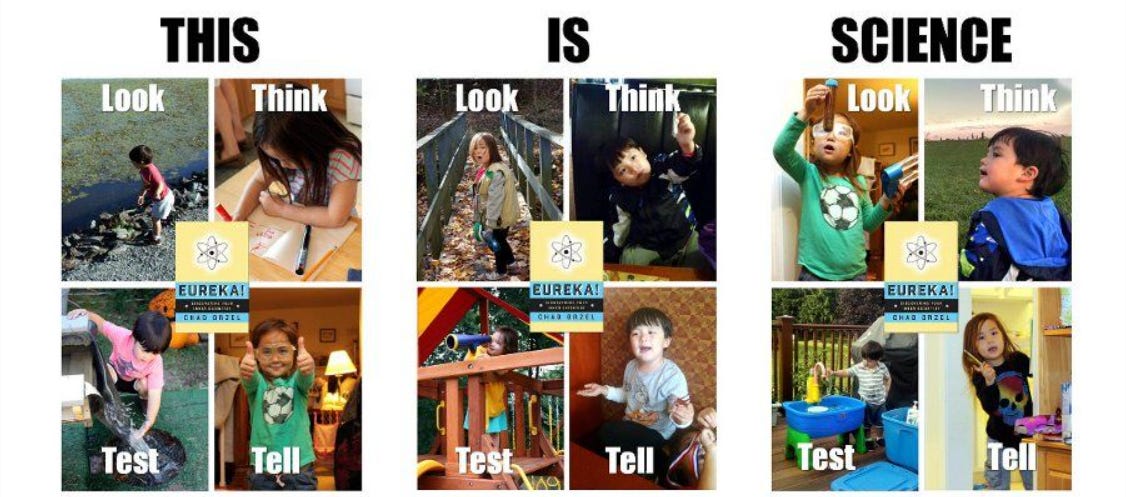
The whole point of the book is that this iterative process of building and refining models of the world is a human universal. In every time and every place that we see human activity, we see humans using this process— it’s even central to activities that non-scientists do just for fun (as spelled out in the book).
Any worthwhile education should convey the idea that science is not, in fact, some arcane activity beyond the comprehension of “ordinary people,” but just a refinement of mental processes that everybody uses, all the time.
— Science is Iterative and Cumulative: This is to some degree implicit in the previous, but worth breaking out for emphasis. Our best models of the world are the product of endless repetitions of the Look-Think-Test-Tell cycle, and will continue to be refined through that process on into the future. New models don’t fully replace old ones, but rather incorporate their successes: in the appropriate limit, General Relativity reduces to Special Relativity, which in turn reduces to Newtonian mechanics. When and if we develop a working theory of quantum gravity, it will reduce to General Relativity in the appropriate limit, and thus contain Newtonian mechanics.
— Science is Quantitative and Precise: This one is somewhat aspirational, in that the degree of precision that’s feasible to attain will vary from one field to another—very high in a field like particle physics where you can repeat an exquisitely controlled experiment trillions of times, much lower in an observational or behavioral science where logistical issues restrict the number of cases that can be studied. Whether the standard is six sigma or p<0.05, though, the goal is always to make concrete predictions that will be assessed by quantitative means: Does this agree with empirical observations within the quantifiable limits of the uncertainty? It’s a strict standard, and needs to be applied ruthlessly5.
I’d say that those three principles are the core of what anybody ought to know about science as a general activity: it’s a process that is universal, iterative, and quantitative, and it is far and away the best tool we have for refining our understanding of the world and putting that understanding to practical use.
So, as a practical matter, how should this be implemented in an educational context? Again, sticking with approximately the American model of education, I would divide this into two parts, one for the K-12 stage of universal(-ish) compulsory education, the other for the college/university phase.
At the high school level, I would say students should be required to pick up a broad grounding in math and really basic concepts of science. Students should need to take the same number of years of math and years of science as they do years of literature and years of history. This is not the norm— New York requires four credits each of English and Social Studies, but only three each of math and science, for example— but I think that’s a mistake. I’d lean more toward bumping up the math and science requirements, but could be talked into scaling back the English and Social Studies requirements instead.
Those classes will necessarily have more of a conceptual focus, but that’s fine. We don’t need high school kids to necessarily be able to do complex calculations, but they should know the basics of the atomic model of chemistry, the evolutionary paradigm for biology, and the core ideas of Newtonian physics and electromagnetism.
At the college level, my ideal model would be to require two mathematical courses, one calculational (calculus, statistics, etc.) and one more reasoning-based (proofs, logic, etc.— the kind of thing that actual mathematicians do). Those are distinct enough that I think it’s worth seeing both flavors, if only to squash the misconception that math professors are just sitting around multiplying and dividing numbers all day long.
For the sciences, I would also ideally like to see a minimum of two courses in two different areas (so chem and physics, or bio and geo, but not two courses in the same department), one with a classic hands-on experimental lab (mixing chemicals, observing organisms, measuring the motion of things), the other with a computational element (some level of simulation, quantitative data analysis, and data visualization/ presentation, etc.). You could probably put together a well-designed course that does both of these, but the important thing is that both get covered, so two courses.
I kicked around several different phrasings attempting to say that the topics for these should be as contemporary as possible, but really, that’s probably unnecessary at any institution that takes teaching seriously. The majors sequence in any STEM fields will automatically bring in contemporary topics because the whole point is to bring those students up to speed on the current state of the art. And anybody who cares enough to put together a non-majors course in the last couple of decades6 knows that those work best when there’s a hook to catch the students’ interest. So this should happen more or less automatically.
And it also goes without saying that I think state-of-the-art science can, in fact, be usefully communicated to non-scientists in a way that gets across the above principles. As should be obvious from my four other pop-science books. (Two of which have been the basis for non-majors courses in one form or another. A third is the basis for a video lecture course.)
That would be the bare minimum in the ideal world where I luck into a trillion dollars and get to set up my own ideal university— the package of STEM courses taken by students majoring in not-STEM subjects. Majors would obviously take more than that, and the goal there should be to graduate students who are prepared to move immediately into graduate study in whatever their chosen field is, should they choose to do so. That’s true of any field, though— if you’re not positioning students to be able to move to the next level, you shouldn’t be charging them tens of thousands of dollars a semester for the degree.
In the I-get-infinite-resources-to-start-a-university world, there would, of course, also be parallel requirements for covering not-STEM subjects. If I really feel like picking a fight at some point I might try to lay those out, but this is long enough already. And I think it’s accomplished the basic goal of fulfilling my need to Say Something on this subject, which will let me get back to my actual class for this term…
I don’t always do manifestos like this, but if you like it and want to see more, here’s a button:
And if you want to either argue with me or offer me a blank check to start a new college, the comments will be open:
Further complicated by the fact that I sprained my left ring finger playing basketball yesterday, making typing a chore.
Ask your parents.
I did, after all, attend a well-known liberal arts college and have spent a quarter-century teaching at another…
Sadly, this is far and away the worst seller of my books…
I am aware that this creates problems for some of the more speculative branches of science, including big swathes of cosmology and particle theory. I would say two things, though: first, that people in those fields are generally trying to get to a place where they can make quantitative and testable predictions, but both theory and experiment are Really Hard so their ability to do so is pretty limited. More importantly, though, while these fields are overrepresented in the media, they in fact represent a weird and tiny fraction of science as a whole, and my goal here is to lay out principles that capture the bulk of the activity that is unquestionably scientific in nature. Sorting out the exact status of bizarre edge cases is a job for philosophers.
One of the more maddening recurring themes in the ex-Twitter threads that were the proximate cause of this was the assertion that science courses not using a Great Books approach are all just dry recitations of facts to be memorized. That hasn’t been considered a good model in decades, and I find the repeated assertion that it’s all we do to be ignorant bordering on insulting.
I’m so grateful for this. I work at a small liberal arts college and we’re actively discussing what our General Education (ie Liberal Arts Core) should be.
Just yesterday, I found myself as an art historian in the strange position of arguing against a scientist who doesn’t think a lab science should be required. His feeling was that a humanities major wouldn’t learn enough about science for it to be worth it. Not being a scientist, I didn’t really have the tools to articulate what you do here.
So, thanks! I now have these arrows in my quiver.
Mostly out of curiosity, have you considered what the "core" electromagnetic concepts would be for high school students in detail? I feel my view might be a bit skewed, but your post stimulated me to start thinking of a potential list that seems like anyone should be able to take away for the long term:
there are two types of charges which attract and repel each other, similar to gravity;
visible light and "invisible light" (many but not all types of radiation) are made of electromagnetic waves;
electricity and magnetism are related to each other and can be used to convert electromagnetic energy into mechanical energy and vice versa (at high efficiencies).
Maybe lasers are NOT produced by focusing sound waves should be included since I am still stunned by the number of people who get that question wrong in general surveys across the world.