
Spring Forward, Stay Forward?
On the latest in Daylight Saving Time nonsense

I was on the radio in New Orleans yesterday to talk about the latest effort to get rid of the twice-yearly changing of clocks that’s been observed (at least intermittently) since WWI. This is a bill passed by the House of Representatives, who apparently have nothing better to do, that would mandate year-round Daylight Saving Time— that is, if it took effect, we would not do the “Fall Back” this November, and would just stay with the current clock settings year-round.
I’ve written and talked about this a bunch, since I’m readily discoverable as a guy with a book about timekeeping (buy my book!). This being in the news again has led to a small flurry of interest in my takes on DST, so I might as well do another round for the blog. I’ll throw this one in Q&A format, just for the hell of it.
So, why do we do this clock-changing thing again? Well, it started in Europe during WWI, as a way to cut down on the need to run lights. By artificially pushing the time of sunset an hour later, you cut down on the amount of fuel you need to burn lighting homes and offices, and that fuel could then be redirected to the war effort. When the US entered the war in 1917, we joined in the clock change, for more or less the same reason. It continued in a patchwork way through the 20s and 30s, then was adopted nationwide again during WWII, for the same reason. After the war it was again sort of spottily observed until the current system was formally imposed by law in the 1960s.
If this was a wartime measure, why didn’t it just go away entirely, like the various food and material conservation measures that they also put in? I don’t know of a really good reference on this, but it’s basically because, as it turns out, people like having late sunsets in the summer months. It gives you time to linger outdoors after work and dinner, when it’s cooling down but not yet dark, and thus about as nice as it gets all year in most of the US.
If late sunsets are so great, then why change back? Why not just keep the clocks forward all year round? Because the flip side of the change is that sunrise also happens later. This isn’t a big deal in the summer when we have 14+ hours of daylight1, because the “late” sunrise is still plenty early. In the winter, though, the story is very different— we dip down to 9-10 hours of daylight, and the late sunrise starts to encroach on the working day.
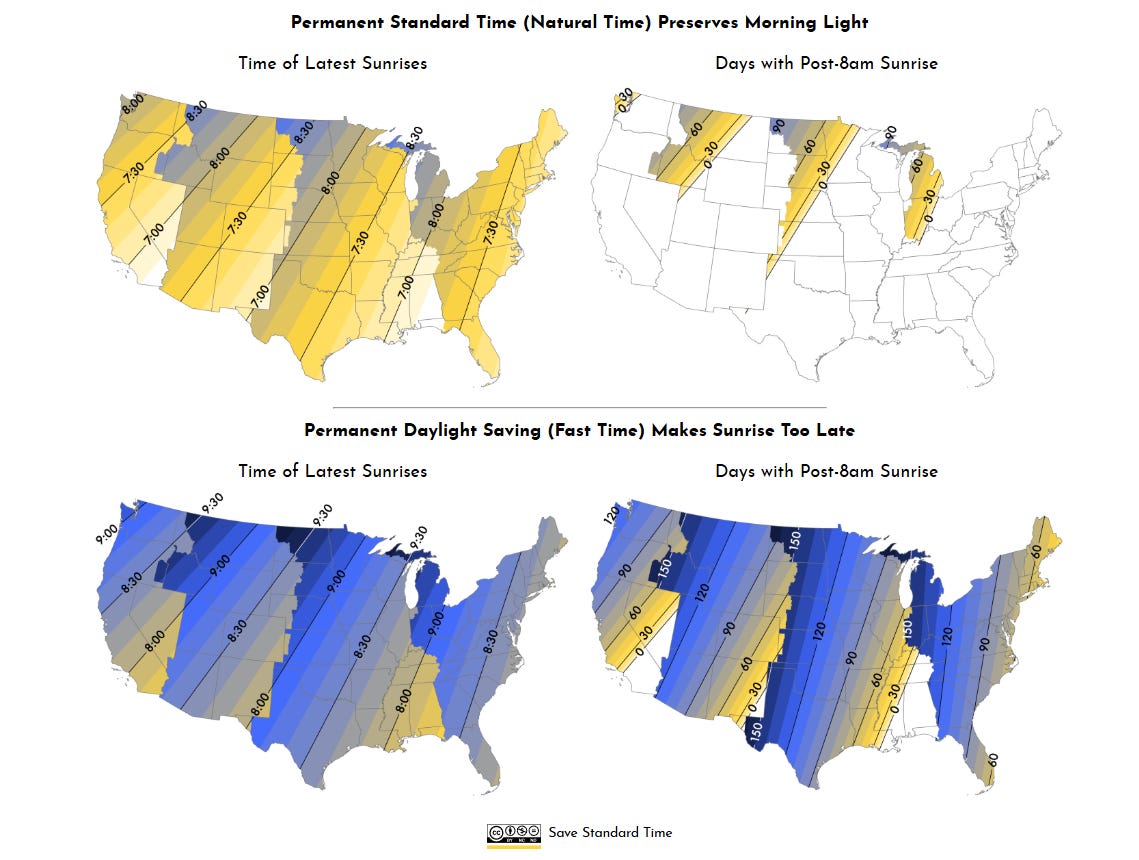
And, as it turns out, while people like late summer sunsets, they hate late winter sunrises. Which, as you can see from the maps reproduced above, can get very late indeed— even setting the clocks back as we do, there are parts of the country where December sunrises happen after 8:00 am. If we kept the clocks forward year-round, as the current bill would have us do, those post-8am sunrises would hit a huge swathe of the population.
OK, but who’s even up early enough to see sunrise? Yeah, this is the stock response of smug dickheads on the Internet, who tend not to have small children who would be riding the bus to school in the dark, and/or who work jobs whose hours are flexible enough that they can just sleep until daylight.
I used to be one of those people, but having kids forced me to become a Morning Person— you need professionally designed explosive charges to get SteelyKid out of bed before 8am with under an hour of constant nagging, and the elementary school bus pickup time in our neighborhood was 7am. I’m now one of those people who wakes up no later than 6am even on vacation2 which means I’m up before sunrise for a large chunk of the year, feeding and walking the dog before everyone else in the house wakes up.
And as much as I’ve grown accustomed to it over the last dozen or so years, it sucks. If you are not already a morning person, I assure you that you are not prepared for how much you’re going to hate having it be dark out until 8:30 or 9:00 in the morning.
Really? Really. In fact, we’ve done this experiment— in the depths of the 1970’s oil crisis, Congress passed a law calling for a two-year trial of year-round Daylight Saving Time, starting on January 6, 1974. It was so wildly unpopular that they repealed it by October, and the “fall back” time change happened as usual.
So, should we just go to permanent Standard Time? There’s a vocal constituency for that, too, which is where I got those maps up above. They praise Standard Time for being more in tune with the Natural Order of Things, and talk a lot about body clocks and circadian rhythms and all the rest. They cite various studies and sleep specialists about the many and manifest benefits of early-morning sunlight to argue that the only right and proper thing to do is to stick with earlier sunrises and sunsets year-round.
I sense from your tone that you’re not really in this camp? Not especially, no. I mean, if you put a gun to my head and made me pick one of the no-clock-change options, I’d probably go with year-round standard time. I’d also seriously question the life choices that led you to threaten murder over something this inconsequential.
But what about the medical studies? Most of this stuff comes from medical researchers who study sleep, so of course their recommendation is to optimize everything around their particular area of specialization. But we don’t take medical recommendations as dispositive in any other area of life— if we did, we wouldn’t eat salt, or fat, or much of anything with, you know, enjoyable flavor.
Medical advice is absolutely one of the inputs to making public policy, but it’s just one, and needs to be balanced against other interests and priorities. It’s entirely reasonable to decide that it’s worth sacrificing quality sleep in favor of longer summer evenings, in the same way that we’ve decided that it’s worth sacrificing some degree of cardiac health in favor of bacon cheeseburgers3.
Is it really? It’s at least a plausible outcome. At the very least, it’s not any more artificial than what we’re already doing with time zones.
What? Well, look at those maps again— we’re already sacrificing the sleep quality of large swathes of territory by pretending that Michigan and Miami are experiencing the same time of day. We’ve decided to set our clocks to the same time across enormous swathes of territory, meaning that even under permanent standard time there are big regions where the latest sunrise is well after 8am.
Yeah, but basically nobody lives in those places… Which is the stock answer of smug dickheads on the Internet who live in NYC or LA.
My point is that if you really want to commit to the “natural time” bit, you should be pushing for the abolition of time zones, which are already putting people’s circadian rhythms out of whack. Nobody’s really doing that, though, because everyone recognizes that a truly natural time solution where everyone’s clocks are pegged to the local position of the sun would be an absolute nightmare for a modern technological society where we regularly need to coordinate activities across huge distances. The convenience of having clocks from Miami to Michigan set to the same time is worth the hassle of having the sun rise earlier than would be ideal in Florida and later than would be ideal in the Upper Peninsula.
Once you’re doing that, it’s not clear to me that it’s any worse to shift the clocks twice a year for the convenience of having late summer sunsets and early winter sunrises.
How about we split the difference, and move everything back half an hour? That’s the most popular flippant alternative, but think carefully about whether you really want to ask the general population— who already struggle to figure out a one-hour shift— to have to add or subtract 30-minute increments when dealing with people in other countries.
So, at the end of the day, you’re boringly pro-status-quo? Pretty much. I’m up really early year round, and The Pip is a baseball player, so the current system gets me two things that I enjoy: long summer evenings for Wholesome Americana and earlier winter sunrises so I’m not awake for three hours before daylight.
Mostly, though, I think that anyone making this a top legislative priority is at least a little bit of a whackadoodle4.
On that, we can agree.
So, there you go. You know, until the next time… If you’d like to be among the first to read the next time, here’s a button:
And if you want to take issue with any of this, the comments will be open:
Some sections of the southern part of the US dip below 14 hours, but most of the country is getting more than that; in Schenectady, our longest day is almost 15 and a half.
I have lots of pretty photos of sunrises taken from cruise ships and resort beaches in my Google Photos.
Mmmmmm…. Bacon cheeseburger…
Technical term.
Another way to split the difference would be to adjust the time zone boundaries. A non-starter, I know, but still…
Or adopt the Chinese solution of a single national time zone, adjusting local opening/closing times to suit. (Sorry, AK & HI)
Just realized that this spring-forward hour needs to be a federal holiday with one hour of mandatory holiday pay. Doing it on a Friday will give people the most time to adapt before Monday; making it a paid holiday would prevent businesses from benefiting from reduced energy bills, in exchange for making everyone else suffer by losing sleep or free time. If everyone gets that hour paid, no matter what, then people with swing, mid, off-schedule, or hourly shifts are compensated too.
People need to be compensated for the inconvenience if the benefits of spring forward are large enough to justify keeping it.