
Hell Is Other Academics
Notes from the nadir

The last batch of stuff I’ve posted On Here has been relatively lightweight— personal notes or pop-culture content, with not all that much about politics or academia or the collision of the two. This is not for a lack of potential topics— there’s plenty of Stuff out there, and there have probably been a half-dozen occasions when I’ve sat down at the computer, clicked over to the Substack editor tab, and said “OK, time to write something serious about the state of the academy.”
And every time I have, it’s gone nowhere. Well, not exactly nowhere— it’s maybe more precisely correct to say that I’ve gone somewhere. Specifically, after a few minutes of pondering, I say “Fuck this for a lark,” and go off for a bike ride or a hike instead, because my esteem for academia as a whole, and thus my interest in writing about it, has hit an all-time low1.

This is largely due to local events that it would be inappropriate to talk about in any detail, but I find myself somewhat in need of catharsis around this issue, and ex-Twitter has conveniently provided an external case study that I can use as a concrete-ish example. Specifically, this set of tweets from Tyler Austin Harper, and the various responses to them and other follow-up exchanges:
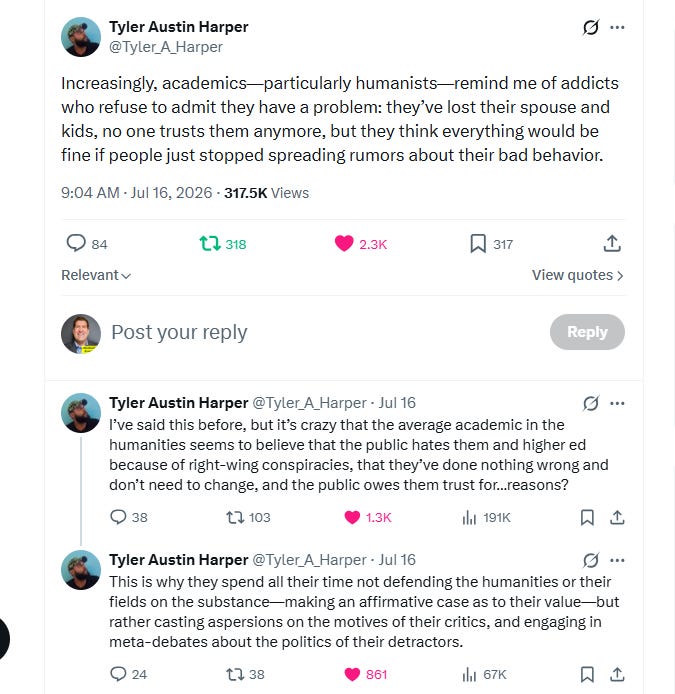
The immediate responses to this generally fall into a few basic categories:
— “Even if we have lost the public trust, why should we care about the opinions of people who are stupid and terrible?”
— “Only right-wing lunatics think there’s anything wrong with academia, therefore Harper is clearly in favor of [caricature MAGA position]2”
— “Harper quit academia to become a full-time columnist which means he’s just a jealous loser who couldn’t hack it and this is all sour grapes.”
— “The only genuine problems with academia are crises that were deliberately engineered by billionaires and corporations because [some linear combination of ‘our ideas are a threat to their power’ and ‘they’re stupid and terrible'].”
As arguments, these span the range from “terrible” to “outlandishly terrible.” But they’ve drawn a ton of “You told him!” replies and approving quote-tweets. Harper’s game for a fight, so this extends into a number of spin-off threads in which various people double down on versions of these basic responses. He seems to be having a grand time, so, you know, godspeed to him, but I find the whole thing incredibly dispiriting.
The worst part isn’t that I think this shows that the people involved are stupid; quite the contrary. There’s a considerable degree of intelligence and craft going into some of the terrible responses. What’s going on is a combination of motivated reasoning and tribalism: the people putting forth terrible arguments don’t want to change their behavior, so they’re skillfully deploying every tool in the “critical thinking” kit to construct justifications for not changing.
There’s a sense in which this is even inevitable, given the way modern academia works. One of the keys to a successful academic career is finding ways to sell whatever you study as the most important thing in the history of Important Things: an incremental advance in a measurement technique heralds a technological revolution, a regression coefficient with p=0.048 offers deep insight into human character, a tiny aesthetic choice carries immense moral weight. This readily finds applications in institutional and sectoral policy arguments: if you’re clever enough, any policy disagreement can be cast as impacting some fundamental principle, and on questions of fundamental rights, there can be no retreat. It’s not only not wrong to be doing whatever we’re doing right now, it’s a moral imperative to be doing exactly what we’re doing right now, and even the suggestion that anything might need to change is an outrage.
Combine this tendency to oversell things with the tribal inclination of like-minded folks to rally behind those they perceive to be on their team and you get… well, what you see with the responses to Harper. Terrible arguments are accepted and cheered because they’re flattering to the preferences of a particular swathe of academics, and you get a bonus dollop of middle-school-esque “…and your beard is stupid, too!” personal attacks. These are people who ought to know better, and in fact frequently do— the same collection of tactics employed against their preferred views is immediately identified correctly as what it is. But motivated reasoning and tribalism are powerful things, allowing even very smart people to convince themselves that terrible arguments are, in fact, devastatingly powerful. Or maybe just that the incredibly high stakes justify the deployment of bad arguments, because any compromise would be unconscionable.
The obvious counterargument to this specific example is “Forget it, Jake, it’s (ex-)Twitter.” That this is the behavior of a handful of Excessively Online wing nuts, and should not be taken to be representative of academia more broadly. And there’s certainly an element of truth to that, in that the absolute number of people who engage in this sort of behavior is, in fact, fairly small.
The problem, though, is that they’re widely distributed— every campus has a few. Without going to an inappropriate level of detail, the above pattern is very much of a piece with the local aggravations that have made the last few academic years so infuriating for me. The number of people doing infuriating things is small, but they’re very loud and incredibly persistent and as a result can wield outsize influence.
And, you know, I am just fucking done with these people and this behavior. It’s not even August yet, and I find myself regarding the upcoming academic year with a sense of dread, thanks to the sure and certain knowledge that I’m going to have to endure a shitload of this particular pattern of behavior. Even when it’s in support of goals that I mostly agree with, it’s so gross and unappealing that I don’t want to be associated with it. The fact that there’s an as-bad-or-worse contingent (mostly outside institutional academia) pushing in the other direction doesn’t do anything to reconcile me to this approach, either3.
Put this together with a different set of highly predictable and deeply maddening behavior from a different sector of campus, and I find myself pushed into “Do I really want to keep doing this job?” territory. And when I find myself there, well, it’s time to step away from the keyboard and take a long walk to a nice view of literally anywhere other than campus.

Kind of a bummer, but probably useful to get off my chest. We’re going on a family vacation in a week or so, and I think I’m going to try to find some physics stuff to talk about until then, which will hopefully provide a bit of a reset. If you want to see where that goes, here’s a button:
And if you feel so moved, the comments will be open:
This is quite a statement, as there have been two past occasions when I was sufficiently pissed off and/or burned out that I took a pay cut for a year to get out of having to be on campus.
I find this one darkly hilarious, as Harper is someone I have occasionally muted for being too annoyingly leftist.
“He did it first!” has never been a winning argument, as I told my kids when they were in elementary school.
I'm curious. What do you advise people to do when someone critiques them whose priors or assumptions are dubious, whose motives are bad, and whose behavior in any sort of subsequent dialogue is going to involve a lot of rapid-fire moving of goalposts? I spent my first fifteen years or so of academic blogging diving into conversations in good faith with bad-faith critics who were using a lot of the same tropes and hooks as Harper and I can only remember two or three conversations where I thought something valid and interesting came of it. Otherwise it was a lot of Charlie Brown and Lucy with a football cosplaying where I ended up flat on my back a lot.
Now if you basically are saying "I agree with what Harper says", then maybe the quicker route is to just say "I agree with what Harper says", because giving advice to people about what you think is tactically or intellectually terrible about their answers is in that case just insincere concern trolling. Harper's view is that the answers being terrible (as he sees it) is confirmation that everything he says is right, and you seem kind of adjacent to him a bit here. If that's the case, you wouldn't expect it to be different, and might as well just say, "I agree, fuck all you guys" and lay out your substantive complaints and own them.
Or you don't think Harper is right, but you think people are being dumb in how they respond to him. In which case, how ought one to respond to a critic like Harper? There's always the argument that you just ignore bad-faith attacks from tendentious critics, but there's a pretty good case for saying that this is precisely what has given the far right a lot of space to run the tables in various culture war crusades against academia.
I wanted to post a photo of me, daughter and grand daughter atop Eagle Cliff on Cypress Island. Sad site doesn't allow.
I do want to comment as an old failed engineer that I admire folks who can jump into the humanities and think hard about the human condition and bring some new insights to us slugs. I think in short sentences or with a struggle a paragraph or two. Pages and book length is beyond my capacity.
The human condition is a puzzle beyond the capacity of the human brain to puzzle out.
Thanks for working on the puzzle