
Does a Crosswind Push Harder When You're Going Faster?
Forces and perceptions and kludgey numerical simulations

Last week, a colleague who is a very Serious Cyclist— the kind of guy who bikes up hills I’m not wild about driving in a car—emailed with a physics question about the effect of wind gusts at different speeds:
Are you more likely to be impacted by a crosswind (blown off your course, blown over, or just having to lean into the wind to stay upright) if you are going at a higher speed, all other things being equal (bike, position, etc)? My gut feeling is yes, and it certainly felt like I was being buffeted more when I was going faster, and felt less sketchy when I slowed down, but perhaps that’s just perception?
This is a slightly subtle question in that it’s a little tricky to quantify: What exactly counts as an impact from the crosswind, and how would you measure it? This ended up taking me down a bit of a rabbit hole that involved dusting off old VPython code, which was a pleasant way to spend a couple hours on a rainy weekend, and thus is decent fodder for a blog post.

The Basic Physics:
The relevant force here is air resistance, which acts opposite the direction of motion through the air and increases like the square of the speed. So, if you feel some drag force at a speed of 5mph, increasing your speed to 10mph would get you four times the drag force. Which is why it’s much more important for bicycle racers to hunch over their handlebars than it is for kids riding around the neighborhood— drag is a much bigger factor at high speed than at low speed.
Adding wind to the picture changes the effective speed, which is easiest to see if you think about winds directly in line with the motion. If you’re biking at 5mph into a 2mph headwind, that’s the same as biking through still air at 7mph (not quite double the force), and if you’re biking at 5mph with a 2mph tailwind behind you, that’s the same as biking at 3mph through still air (a bit more than a third of the drag force).
This is a little more complicated in the case of a crosswind, though because that also changes the direction. Biking, say, west at 5mph with a crosswind at 5mph from the south increases the total force, but not by as much as it would if you just added the speeds. If you’re thinking about just the scale of the total force, you can think of these as adding like the sides of a right triangle in the Pythagorean theorem: the total drag force on a cyclist moving west at 5mph with a 5mph crosswind would be like that from moving a little more than 7mph, giving double the total drag force.
It also, importantly, changes the direction of the force, so it’s not just along the direction of motion any more. A crosswind coming from the south means a westbound rider feels a force that’s pointing north and east.
And it’s that change in direction that makes it a little complicated to assess what we mean by the effect of the force. If a cyclist moving at 5mph gets hit with a 5mph crosswind the total drag force will double, but if they’re moving at 10mph there’s still an increase, but it’s proportionally less: the total drag force increases from 4x the drag on a 5mph rider in still air to 5x the drag, a 20% increase. The force increases in absolute terms, but it’s less of a change compared to the straight-ahead drag.
But the absolute magnitude probably isn’t the right thing to think about, here, again because of the direction. The increase in the total drag force means an increase in the sideways portion, and that’s the thing that the cyclist is most likely to worry about. Particularly when you factor in reaction time— a gust from the south will redirect the velocity a bit north of west, which will cause a shift to the north until the cyclist has time to steer south and correct. The faster the bike is moving, the larger that northward nudge will be, and the bigger the correction needed afterwards.
So, from a very general physics standpoint, it’s true that the original speed does change the size of the effect from a crosswind, but as a fraction of the force involved, the extra drag gets smaller as the speed goes up. But the perceived effect— the distance the bike shifts to the side before the rider can correct— gets bigger.
The Model
Drag is kind of a messy force, though— there’s a reason most problems in intro mechanics courses include “neglecting air resistance” as a qualifier— and a proper treatment of it basically always requires some sort of numerical approach. Which isn’t really a thing I do a ton of, but I have a bunch of intro mechanics simulations in the form of programs in GlowScript, one of which was looking at air resistance in baseballs, so I grabbed that and started tweaking it
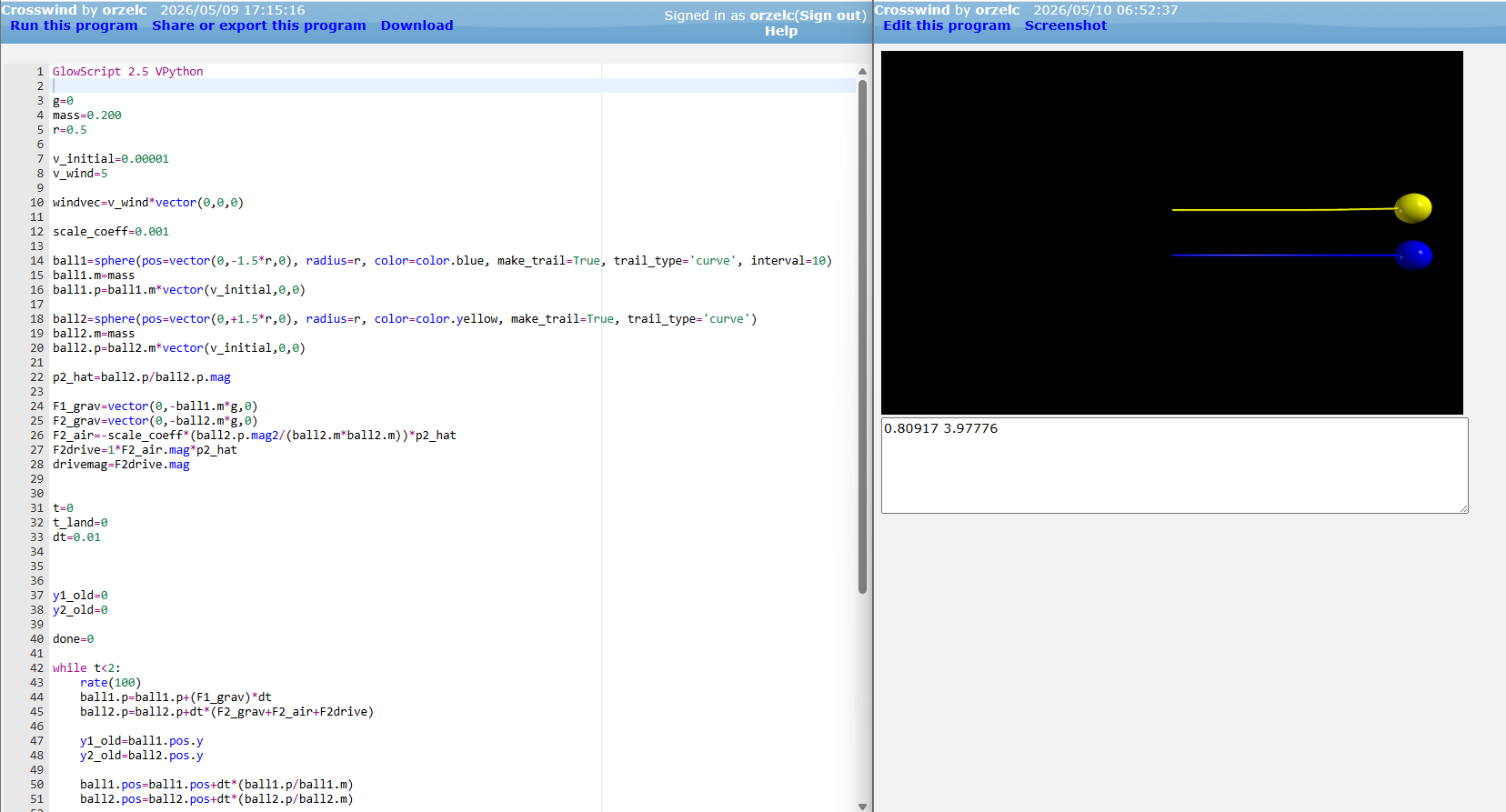
This is very much a toy model of a moving thing, but then anything with drag will necessarily be that because the actual force is dependent on the details of the shape and so on. I’m not dealing with any of that, so this is basically a spherical cyclist: a moving object subjected to a force in the opposite direction from the motion that’s proportional to the speed squared.
What this generates is:
— One object that isn’t subject to any air drag (the blue sphere in the screenshot), just to serve as a visual reference
— A second (yellow sphere) that feels drag but also a “drive” force equal to the initial drag, pushing in whatever the instantaneous direction of motion is. Imagine it as the cyclist pedalling hard enough to maintain a constant speed in still air.
—A “gust of wind” that lasts one second (about a hundred time steps in the simulation), and comes in from the side (pushing “up” in the screenshot). This is added to the velocity vector of the bike before calculating the drag force.
I played around with a bunch of different parameters— initial speed, wind speed, wind orientation, etc.— and ended up mostly looking at a “wind gust” with a speed of 5 m/s (about 11mph) for various initial speeds. For final output I looked at the velocity and position of the object at the end of the “gust.”
The Results:
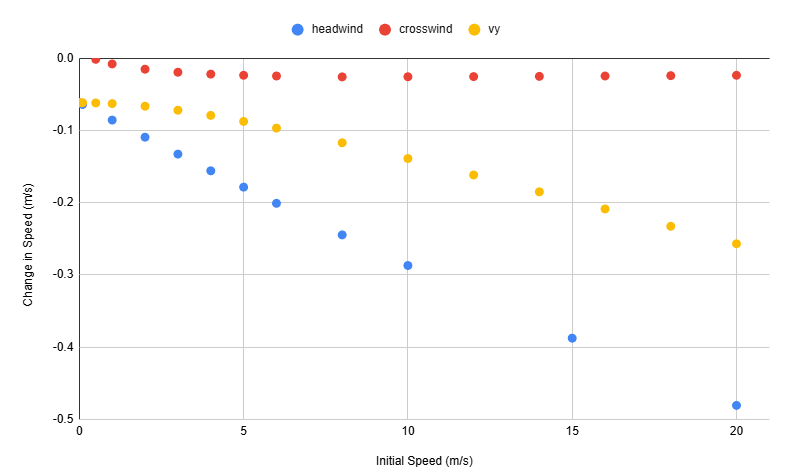
I’m cheating a little bit in this graph because the three sets of points aren’t exactly the same thing, but it’s a compact way of giving a general sense of the problem. The blue points are the change in the final speed of the object after a gust of headwind for various initial speeds— I changed the direction of the “wind” vector to be opposite the direction of the motion, basically as a sanity check on the code. These serve as a useful indicator of the largest the effect of the “wind” could possibly be.
The red points are the change in the total speed of the object after a 1-second crosswind at 5 m/s. You can see that there’s a slight reduction, but not very much. This makes sense because while the wind should increase the overall drag force slightly, its main effect is to add a small sideways component to the velocity, which mostly makes up for the small slowing effect of the increased drag.
The yellow points are just that sideways component (made negative to fall in the same quadrant of the graph as the other two). You can see that the added velocity does, in fact, increase as the initial speed gets larger; determining the exact value is a little complicated because as the object turns the direction of motion relative to the “wind” changes, so the force isn’t really constant.
How much does this added push change the direction? Well, we can figure that out by comparing the sideways component of the velocity to the final total speed, and using that to calculate the angle1 of the final velocity relative to the initial direction of motion:
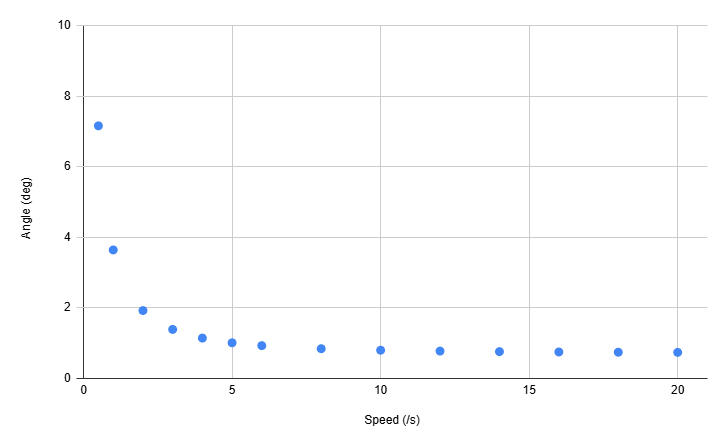
The angle is relatively big when the speed of the object is substantially less than the speed of the wind, because the resulting force is mostly wind not drag. It very quickly drops off to a small and decreasing angle, though. Which is the proportional-change thing I was talking about— the extra sideways velocity gets bigger in absolute terms, but is a smaller fraction of the total.
But what about the perception of the effect? Here’s the sideways distance the object gets displaced by the gust:
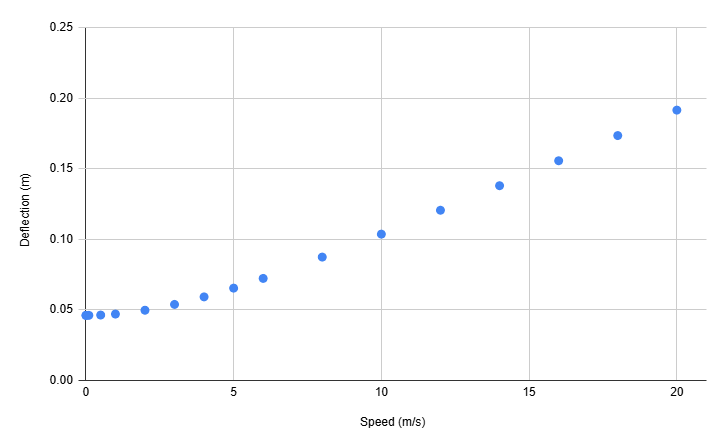
Again, this is consistent with the basic physics picture above: with an initial speed of 5 m/s, one second of crosswind shifts the object to the side by about 6.5cm. At an initial speed of 10 m/s, the sideways shift grows to 10.4cm, and at 20 m/s it’s pushed sideways by 19.2 cm. The exact numbers aren’t the point here (again, this is a very toy model), just the relative shift: a faster initial speed leads to a greater sideways displacement from the same gust of wind.
So, what’s the upshot of all this? Basically, that physics works: the chain of reasoning that comes from thinking about how drag depends on speed gets to the right basic place. The effect of a crosswind gets proportionally smaller as the speed increases, but the practical effect of a sideways shift that needs to be corrected gets bigger, and probably explains the perception that crosswinds are worse with increasing road speed.
Is this needlessly complicated? Almost certainly, but it amused me on a Saturday morning that was grey and dreary, so I consider it time well spent. I don’t do this sort of post all that often, but if you enjoyed it here’s a button:
And if you would like to suggest other things to look at, in this problem or other similar things, the comments will be open:
That is, we find the inverse sine of the yellow points divided by the red points.
We’re going to go descend Rynex Road together and you can chalk all this out on the road for me.
I was going to say, "what about countersteer and angular momentum (increases with bike speed" and... Then I checked. So, you may find these interesting: https://badbicyclescience.com/tag/angular-momentum/